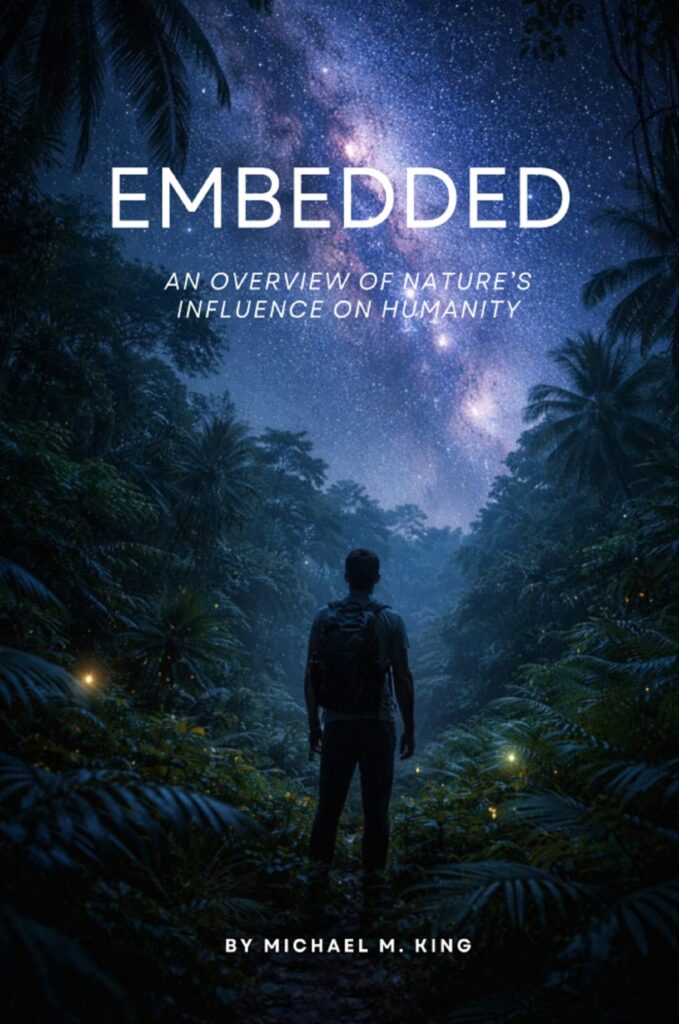
 Embedded: An Overview of Nature’s Influence on Humanity
Author: Michael M. King
Imprint: Humanivy Publishing
Release Date: June 23, 2026
ISBN: 979-8295744433
Genre: Self-Help, Psychological, Non-Fiction, Spiritual
Available Formats: Paperback or eBook
Language: English
Paperback: 250 pages
Item Weight: 12 ounces
Size: 6 x 0.57 x 9 inches
Explore Authors Mini Review:
“Michael King insightfully explores human nature through the lens of nature, evolution, and psychology in this riveting read.” ★★★★★ – Explore Authors Magazine
Where to buy:
Amazon | Barnes and Noble | Walmart | Books-a-Million | New Book Authors Bookstore | Ebay | Alibris | Powells | Booktopia | Blackwell | Liftbridge Books | Biblio | Waterstones Books | AbeBooks | ThriftBooks | Better World Books | City of Asylum Books | Prairie Lights Books | Magers and Quinn | Parnassus Books | Bookscape | Strand Books | Browns Books | Fishpond | Buchfreund | Zvab.com and many other fine retailers
Where to buy: eBook edition [Coming Soon]
Amazon Kindle | Barnes and Noble | Walmart-Kobo | Everand | eBooks.com | Booktopia| Indigo | New Book Authors Bookstore | Porrau.mx |
About the Book:
MIND. BODY. NATURE.
Life Can Be Wonderful and Perplexing, but not Magical
Humans are clearly the only truly conscious beings on Earth, despite the exceptional intelligence seen in many of our vertebrate relatives, such as mammals and birds. Accepting this idea is a good starting point for understanding our impressive history of cultural development, including harnessing energy, extending lifespans, and changing the planet, but no magic was involved. The modern human brain, though quite remarkable and mysterious, evolved from earlier brains during human evolution. While some still argue that humans deserve “exceptional” status beyond biology, our species emerged from natural processes and remains an essential part of Earth.
Part of human culture involves learning and passing on knowledge. However, we are not born as blank slates waiting to be shaped by our parents, peers, or society. If that were true, we could easily be programmed regardless of personality, intelligence, sex, heredity, or other influences that are not learned. Even if we could create any environment we wanted, we would never escape the square peg in a round hole problem. Our culture often promotes the idea that we are mostly “the sum of our choices” or “architects of our own future.” These messages can be inspiring and potentially helpful, but they are rarely a literal truth for most people, given the many changing challenges from inside and outside forces. Humanity cannot be fully understood without recognizing nature’s influence and the unpredictable results it can produce.